Skip to content

CNC Milling

Precision CNC milling for housings, plates, brackets and complex profiles in metal and plastic, from a single prototype to repeat production batches.

Tolerance
±0.01 mm typical, tighter on request
Maximum part size
Up to 2000 × 900 × 200 mm (machine dependent)
Surface finish
Ra 0.4 – 3.2 µm as machined
Lead time
5–10 working days after drawing approval

How we hold this quality

Fixtured for the part

Parallel-machined fixtures and soft jaws hold thin walls and complex geometry without distortion, which is what keeps datums aligned across a batch.

Two-operation control

Datum transfer between the first and second operation is planned before the part is cut, so bolt patterns and mating faces stay in tolerance.

In-process inspection

Operators check critical features against the inspection plan during the run, not only at the end of it.

Finishing to match

Bead blasting, anodizing, plating and painting are managed with the machining so the finished part arrives ready to fit.

Milling covers most of the custom parts we make: housings and covers that need flat, parallel faces and accurate bolt patterns; brackets and plates with pockets and slots; and complex three-dimensional profiles that need to be cut from more than one direction.

How the part is planned

Before cutting, we decide the machining sequence, how the part will be held in each operation, which faces become the datum, and how the critical features will be measured. That plan is what allows a thin-walled housing to be machined without chatter marks and a bolt pattern to line up with the mating part.

Materials and finishes

Aluminium is the most common choice for machined parts because it machines quickly and anodizes well. Stainless steel, carbon steel and titanium are used where strength, corrosion resistance or temperature resistance matter more than cycle time, and engineering plastics cover insulating, low-friction and RF-transparent applications.

See 4-axis machining and 5-axis machining if the part needs machining from several directions without losing the datum, or CNC turning for rotational features.
Process & part gallery

Fixture plate and finished machined components
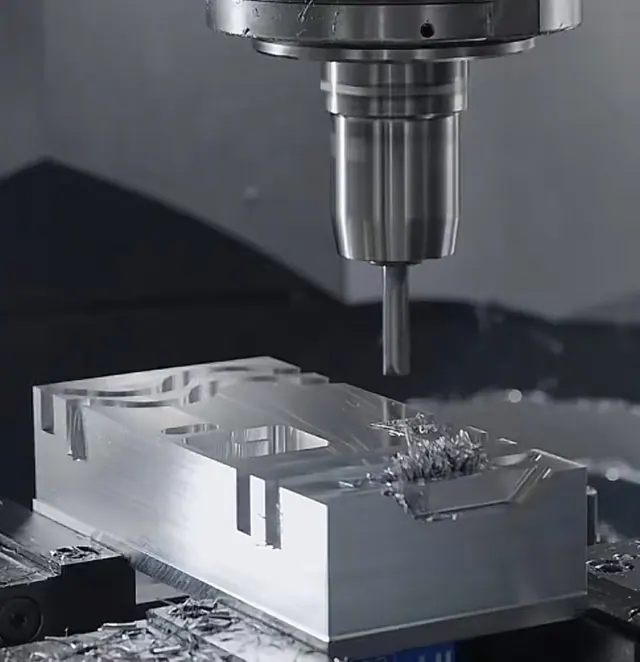
Aluminium block with machined perforations and pockets
Machined parts in aluminium and stainless steel

How it works

From drawing to delivered part

  1. 1

    Send drawings

    Upload STEP, IGES, DXF or PDF files with material, quantity and finish.

  2. 2

    Engineering review

    We check manufacturability, tolerances and finish for this process.

  3. 3

    Quote and approve

    You receive unit price, lead time and any design questions in writing.

  4. 4

    Produce & inspect

    Manufacturing runs against an agreed inspection plan.

  5. 5

    Ship and support

    Parts are packed, documented and shipped, with support for revisions.

FAQ

CNC Milling — frequently asked questions

How should I prepare my 3D model for milling?

Supply the part as it should ship — final geometry, tolerances and finish callouts. Let us know which faces are cosmetic and which features are critical; that decides how the part is held and which surfaces are machined in the first operation.

What is the smallest feature you can machine?

As a working rule, plan for a minimum internal radius of 1 mm and a maximum pocket depth of about 4× the cutter diameter. Send the drawing and we will confirm during the engineering review rather than guess.

Do you machine prototypes and production parts the same way?

The first part is produced on the production process wherever possible, so the geometry that passes validation is the geometry that repeats in the batch. Where a cost-saving adjustment is needed for volume, we agree it with you before production.

Start a project

Request a cnc milling quotation

Upload your CAD files with the material, quantity and finish. Our engineers will review the drawing and reply with pricing and lead time.