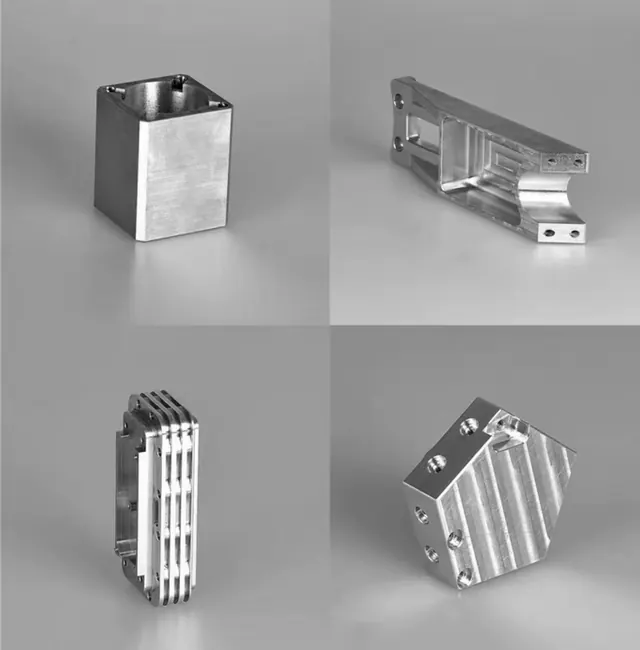
Telecommunications manufacturing
RF housings, heat sinks, antenna hardware and mounting components with controlled conductivity and environmental performance.
Telecom hardware has to do two things at once: look acceptable on a mast or in a cabinet, and perform electrically. That usually means selective finishing — a protective finish in most places, bare metal exactly where it must conduct.
Typical work
Equipment housings and covers, heat sinks and thermal plates, antenna brackets and mounting hardware, connector panels, and filter or cavity components.
Finishing for both worlds
Anodizing gives corrosion protection and appearance, but it is an insulator. We plan masking so that grounding points, connector interfaces and waveguide surfaces stay conductive, and we check those surfaces after finishing rather than before.
What this industry asks of a supplier
Selective finishing
Cosmetic anodizing on the outside with masked, conductive surfaces where the housing has to carry a ground path.
Thermal performance
Heat sinks are machined with the fin geometry and base flatness the thermal design assumes.
Environmental sealing
Sealing grooves, gasket faces and O-ring seats are machined to leave the joint able to seal.
Weather resistance
Outdoor hardware is finished for UV and salt exposure with the correct anodizing or coating system.
Processes we use for telecommunications
Anodizing
Clear, black and coloured anodizing for aluminium parts — corrosion resistance and wear performance in a finish that still looks like metal.
View processCNC Milling
Precision CNC milling for housings, plates, brackets and complex profiles in metal and plastic, from a single prototype to repeat production batches.
View processSheet Metal Assembly
Hardware insertion, riveting, bonding and light mechanical assembly so fabricated parts arrive as kits that are ready to install.
View processPlating
Zinc, nickel, chrome and electroless nickel plating for corrosion protection, wear resistance, conductivity and appearance.
View processMaterials typically used
Parts for this industry
FAQ
Telecommunications — frequently asked questions
Can you keep part of a housing conductive while anodizing the rest?
Yes. Masking is planned before processing so that ground contacts, connector faces and mating surfaces stay bare and dimensionally correct.
Do you machine heat sink fins to a thermal spec?
We machine to the geometry in your model — fin thickness, spacing and base flatness — which is what the thermal simulation depends on. Send the drawing with the flatness callout.
Start a project
Get a quotation for your telecommunications parts
Send drawings with material, finish and documentation requirements. Our engineers will confirm process, lead time and price in writing.